
Alphawave Technologies
Smart Footwear Venture
The first app-controlled adaptive footwear. Pick a color or pattern on your phone and the shoe follows.
Overview
Alphawave was a smart footwear venture I founded and ran from 2020 to 2023. The product was a sneaker with color-shifting panels and a companion mobile app. You choose a style in the app, it sends the command over Bluetooth, and the panels on the shoe change to match.
It was part hardware, part mobile software. We took it from a concept sketch through market discovery, working prototypes, and an MVP definition, then paused before production. This page covers what we built, what we learned, and why we stopped.
Customer's Challenge
Sneakers are one of the main ways young people show who they are, and yet a pair looks the same on day 300 as on day one. The only way to change the look is to buy another pair. Customization exists, but it is slow, expensive, and permanent.
Shoes that adapt like your phone wallpaper: customizable, expressive, and digitally intelligent.
The product vision we worked fromI ran a market gap analysis across fashion tech, smart wearables, and customization products. Four trends kept showing up: self-expression, modular fashion, sustainable personalization, and a digital identity that younger buyers carry across everything they own. Smart wearables were a market of roughly $12B and growing, and almost none of it was on people's feet.
What I built in discovery
- Product vision statement and problem statement
- User personas for sneakerheads, lifestyle users, and creators
- Market size model
- Business model canvas for customizable hardware plus digital experiences
Persona
The Sneakerhead
Three personas came out of discovery: sneakerheads, lifestyle users, and creators. The sneakerhead is shown in full because they set the bar for how the shoe has to look when the panels are off.

Age: 22Life stage: College seniorCollection: 20+ pairsPhone: Always in hand
Personality
Bio
Follows drops, matches shoes to the outfit, and posts both. Runs out of closet space and money before running out of ideas.
Goals
- A pair nobody else has today
- Match the shoe to the outfit
- Something worth posting
Frustrations
- Every new look costs another pair
- Customs take weeks and cannot be undone
- Tech shoes that look like gadgets
How persona discovers the product
TikTok and Instagram creators, sneaker communities, friends.
How persona uses the product
Pairs once, saves favorites, and swaps presets before leaving the house.
Motivations
Customer Journey
From unboxing to a new look
As someone who expresses myself through sneakers, I want to change how my pair looks from my phone, so that one pair can match any outfit without buying another.
Define
Discovery left one question that mattered more than any feature. Can color-changing technology be built into a shoe and still flex, last, and hold a charge? Everything else followed from that.
- How might we let one pair of shoes carry many looks without making it fragile?
- How might we give people real choice without asking them to become designers?
Requirements and Technical Feasibility
Before designing anything in detail, I tested whether the idea could physically work. That meant materials, vendors, patents, electronics, and cost, in that order.
| Exploration | What we did |
|---|---|
| Material feasibility | Evaluated OLED, LCD mesh, flexible e-ink, and electrochromic film |
| Vendor discussions | Met with E Ink Corp and several Shenzhen prototyping labs |
| Legal and patent research | Ran an IP feasibility check and started provisional patent development |
| Technical workshops | Worked through battery integration, Bluetooth Low Energy controllers, and flex PCB constraints |
| Engineering budgeting | Cost modeling for prototype versions and a bill of materials analysis |
The display decision
| Option | What it offered | What ruled it in or out | Call |
|---|---|---|---|
| OLED screens | Full color and animation | Fragile, ran hot, and cost too much | Dropped |
| Static e-ink panels | Color change that holds without constant power | Flexible enough, low power, workable cost | Chosen |
| LCD mesh and electrochromic film | Evaluated as alternatives | Did not beat e-ink on the same criteria | Not pursued |
Deliverable: a Technical Feasibility Assessment and a Build vs Buy Matrix. The decision was to move away from OLED and toward static color-shifting e-ink panels driven by a Bluetooth microcontroller.
Ideation
We went wide on what the shoe could do and what the app could let people do, then cut to what a bootstrapped team could prove.
Prototype and User Testing
Prototyping ran in four passes: concept sketches and 2D renders, low fidelity wireframes in Figma, high fidelity app screens, and physical builds. The three workstreams below ran side by side.
- 3D renders and engineering-ready models in Blender and Keyshot, with battery housing, controller compartment, wiring channels, and removable panel slots
- Physical prototypes on Arduino, then ESP32
- Bill of materials: fabric base, e-textile layer, 3.7V LiPo battery, ESP32 controller, wiring harness, e-ink panel prototypes
- Annotated CAD files and supplier packets for Shenzhen manufacturing partners
- Written in C/C++ for Bluetooth communication, boot sequencing, power management, and driver control
- Logic for real-time color switching and sync timing
- Presets stored in on-board EEPROM memory
- Custom circuit board built with an electrical engineer: power regulation, Bluetooth module, drivers, charging
- Serial debugging and edge-case simulation at each stage
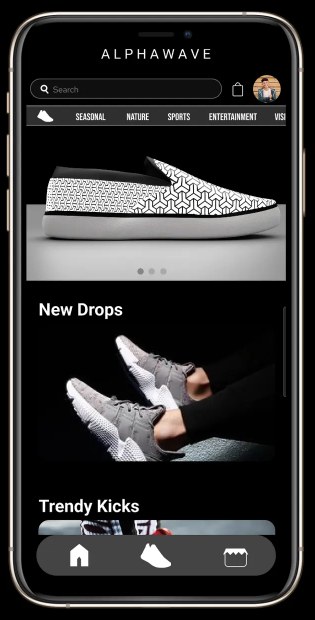
- React Native for iOS and Android, chosen for faster iteration and lower cost
- Bluetooth command protocol that maps each app action to a hex command for the firmware
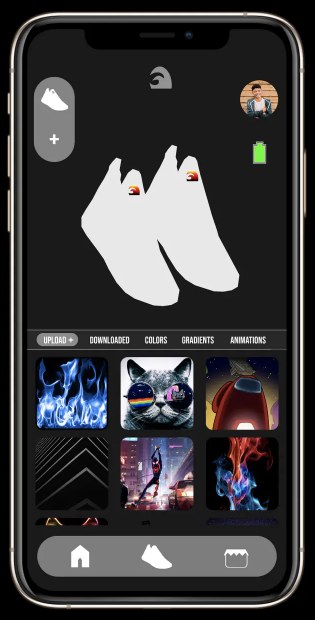
- Screens: Live Preview, Color Wheel, Preset Editor, One-Tap Apply Style
- Preview simulation that mirrors how the real panels behave
How the pieces connect
What testing told us
| Feedback | Value | Outcome |
|---|---|---|
| Real customization is hard to find in footwear | High | Confirmed interest |
| People preferred presets over complex manual editing | High | Simplified the app around presets |
| Worries about durability and weather resistance | High | Redesigned the housing |
| Asked for preset collections such as Seasonal, Minimal, Streetwear | Medium | Added the Collection concept |
| Bluetooth pairing flow caused friction | High | Added automatic device detection and onboarding prompts |
Feedback also fed back into the physical design: wearability, weight distribution, charging method, and how the shoe looks with the panels idle. Deliverables: a usability report with the iteration path for V2, a high fidelity app design system, a design spec for hardware integration, and a clickable prototype for demos and pre-investor pitches.
MVP Definition
Feasibility, user desirability, and cost modeling pointed to the same place. The MVP was an app-controlled static color-shifting shoe. No animation and no video, just color panels that change on command.
- Mobile app integration over Bluetooth
- Quick style swapping
- 6 to 10 starter presets
- Built to withstand real wear
- Favorites
- Collections
- Automatic device detection
- Color wheel and manual preset editor
- Cloud preset sync
- Animation or video on the shoe
- OLED panels
Battery target for the MVP was limited use, under 8 hours per charge. Deliverables: MVP feature list with MoSCoW prioritization, a go-to-market MVP plan, and pitch assets for investor readiness.
User Stories and Acceptance Criteria
Risks and Outcome
Why MVP production paused
What I learned
- Product work that spans hardware and software needs deep technical feasibility and close vendor collaboration from the start.
- People favor simplicity. Users did not want full control. They wanted curated choices.
- Faster does not mean better. Test desirability before building feasibility.
Pricing Strategy
- No retail price was set. Production paused before pricing.
- First-run manufacturing cost came in at $85 to $120 per pair, which is too high without volume.
- Customizable hardware, plus digital experiences in the app.
Lean Business Model Canvas
- Static color-shifting e-ink panels
- Companion app with presets
- One-tap apply over Bluetooth
- Working hardware, firmware, and app built together
- Provisional patent work started
- Direct supplier relationships
- Buying another pair
- Custom sneakers
- Cost per pair
- Battery life per charge
- Pairing success
- Preset swaps per user
- Alphawave = a phone wallpaper for your sneakers
- TikTok creators
- Sneaker communities
- Investor demos
- Fashion students
- Content creators
- Sneakerheads
Next Iteration
Generative AI and flexible display technology have both moved a long way since 2023. If Alphawave came back, it would come back as AI-powered adaptive footwear.